
10 practical ways to build a feedback culture (without making it awkward)
Most organisations don’t struggle with knowing that feedback matters.
They struggle with the everyday moments:
The thing you notice… and don’t say.
The conversation you delay “until next week”.
The email you send because it feels safer than speaking.
The “nice” message that avoids what actually needs addressing.
In our work with technically brilliant professionals stepping into leadership, we see a pattern: the biggest barrier to feedback isn’t skill, it’s behaviour.
So if you’re in review season or simply trying to make feedback less of an “event”, here’s a 10-tip approach grounded in the models we teach in Creating a Continuous Feedback Culture.

10 Practical Tips for Creating a Continuous Feedback Culture
1) Start by agreeing what feedback is (and what it isn’t)
Feedback is not a character judgement. It’s information that helps someone understand the impact of their actions—a tool for learning, growth and improvement. It works best when it’s timely, specific and human.
Remind your team members feedback is not criticism of the person, a way to offload frustration and something saved up for annual reviews
Tip: Ask teams to co-create a simple definition and stick it somewhere visible. Shared language reduces anxiety.
2) Use Radical Candor as your intention check
Kim Scott’s Radical Candor gives a helpful lens: great feedback sits at the intersection of:
Care Personally (I value you)
Challenge Directly (I’m clear about what needs to change)
Care without challenge becomes avoidance. Challenge without care feels unsafe. Combining both builds trust, accountability and learning.
Tip: Before a conversation, ask: “Am I about to ‘be nice’—or be kind?” (Nice is often silent. Kind is clear.)
3) Build trust before you ask people to be brave
Trust at work isn’t about being friends, agreeing all the time, or avoiding challenge. It’s about believing feedback is given with good intent and feeling safe to speak honestly.
Tip: If leaders want more feedback, they have to signal safety in the moment—through tone, curiosity, and follow-through.
4) Make blind spots discussable with the Johari Window
The Johari Window is a simple trust model that helps teams talk about: what we know about ourselves, what others see that we don’t (blind spots), what stays hidden.
The “Open Area” grows when we share appropriately, invite feedback, and respond well when feedback is given. When it grows, trust increases and misunderstandings reduce.
Tip: Encourage leaders to ask: “What might be in my blind spot right now?” Feedback reduces blind spots—but only when delivered with care and clarity.
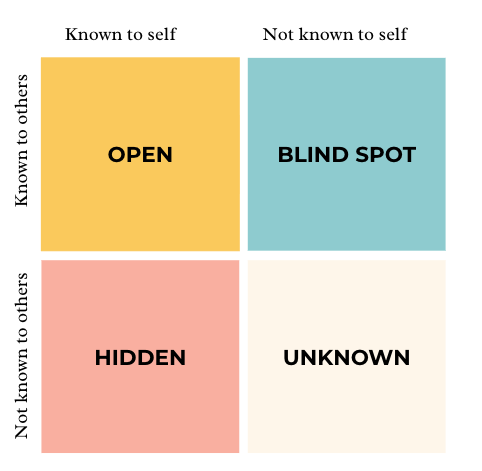
Adapted from:: Luft, J., & Ingham, H. (1955). The Johari Window: A Graphic Model of Interpersonal Awareness.
5) Use one structure (Observation → Impact → Curiosity → Next Step)
When people say “I’m not sure how to say it”, the answer is often structure.
We teach a simple feedback formula:
Observation – what happened? (facts, not judgement)
Impact – what effect did it have?
Curiosity – invite their perspective
Next Step – agree what would help going forward
Clear structure creates calmer conversations. For example…
“Instead of: “You need to communicate better.”
Try: “In yesterday’s meeting, when the update changed last minute (observation), it created confusion for the team (impact). How did it feel from your side? (curiosity) What could we do differently next time? (next step)”
6) Prepare your intention—before you say anything
Before giving feedback, ask yourself:
What specifically did I observe?
What was the impact?
What outcome do I want from this conversation?
Am I doing this to help them grow—or to relieve my frustration?
Tip: If it’s emotional, pause. Write the Observation and Impact as plain, neutral sentences first.
7) Change your language: small shifts, big difference
Good feedback is specific, neutral and respectful.
Helpful language includes:
“I noticed…”
“The impact was…”
“Can I share an observation?”
“How did that feel from your side?”
“What do you think would help next time?”
Language to avoid:
“You always / you never…”
“That was wrong”
“You should just…”
“This isn’t good enough”
Tip: Teach one “replacement phrase” per month. Don’t overwhelm people with scripts—build fluency gradually.
8) Adapt your approach, not your message
Different people prefer different routes in:
direct vs reflective conversations
immediate feedback vs a heads-up
verbal vs written follow-up
Tip: Ask each team member: “What works best for you when receiving feedback?”
Then honour the answer.
9) Make it normal: build three “little and often” habits
Teams with strong feedback cultures give feedback little and often, ask for feedback regularly and treat feedback as part of the work—not an event
Try simple weekly prompts:
“What’s one thing we could improve?”
“What’s working well we should keep?”
“Any feedback for me?”
10) And don’t forget to receive feedback with grace and thanks
When receiving feedback listen without interrupting, ask clarifying questions, notice your reaction and thank the person. Never defend in that moment.
Key insight: How we receive feedback shapes whether others give it again.
If you want a feedback culture, build practice—not pressure
A healthy feedback culture is rarely created by a policy, a performance cycle, or a single workshop.
It’s created by everyday conversations where people experience clarity and care.
If you want to create a feedback culture in your organisation, get in touch about:
our 6-month Lunch & Learn speaking programme (virtual delivery), designed to build shared language and practical habits over time
our Building Better Leaders advanced practice session: The Art of Giving and Receiving Feedback, delivered as a 2-hour webinar